
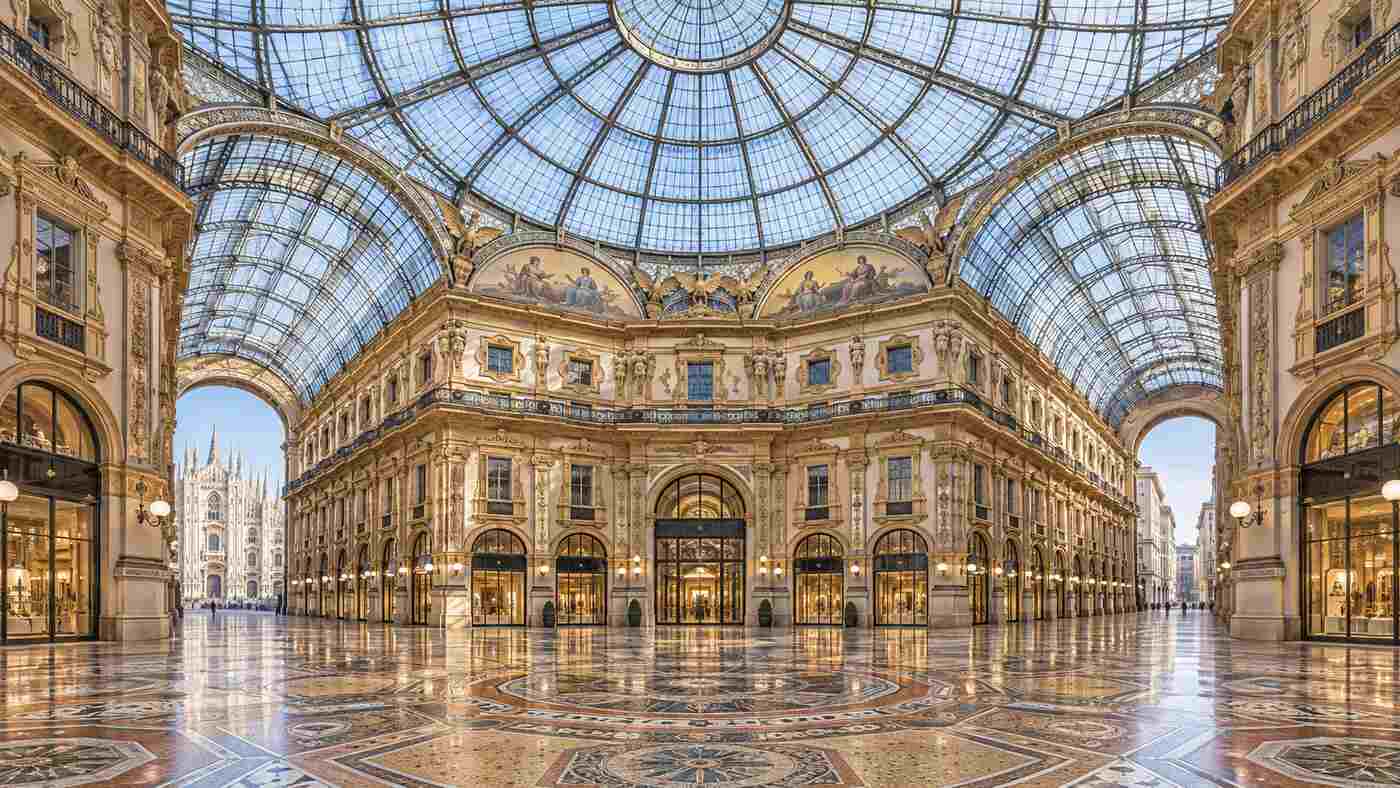
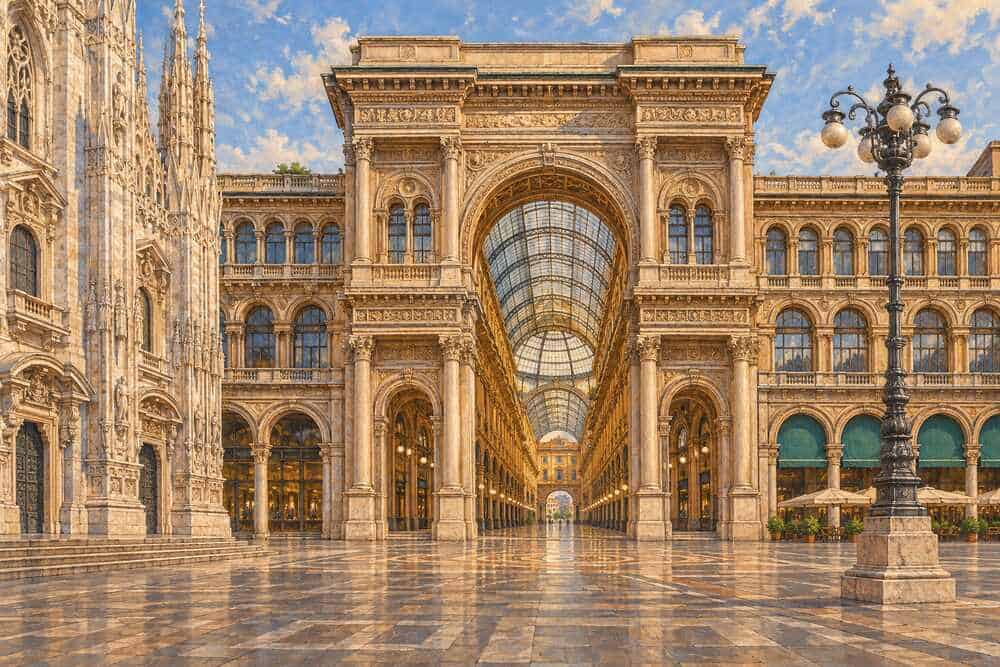
In short: Galleria Vittorio Emanuele II is a covered shopping street in central Milan that links Piazza del Duomo with Piazza della Scala. Designed by Giuseppe Mengoni, it was built from 1865 and inaugurated in 1867, with its entrance arch completed in 1878. It is a public street owned by the City of Milan, so walking through it is free.
Updated 19 November 2026 by Galleria Heritage Guide editors
Milanese call it simply “la Galleria”, and its nickname is il salotto di Milano, Milan’s drawing room. This guide sets out what the building is, how it was made, what to look for inside, and the few things a visitor needs to know. It is an independent reference, not an official site of the Galleria or the City of Milan. For the full story of its construction see our Galleria history from 1859 to 1878, and for its architect read our profile of Giuseppe Mengoni.
What is the Galleria Vittorio Emanuele II?
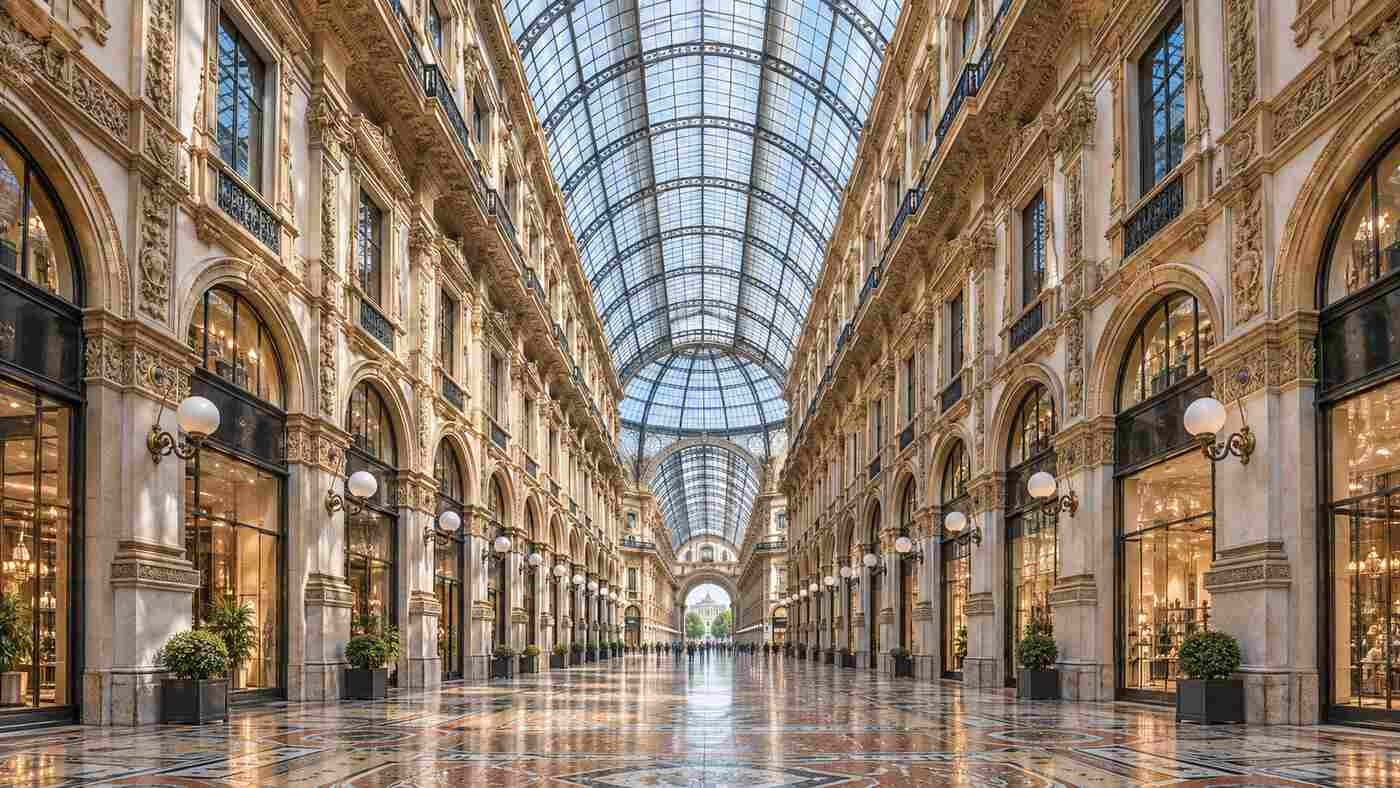
The Galleria Vittorio Emanuele II is a pedestrian street roofed in glass and iron, lined on both sides by four-storey buildings with shops, cafés and restaurants at ground level. English Wikipedia describes it as Italy’s oldest active shopping arcade. Its owner is the Comune di Milano, the city council, which rents the shop spaces to tenants.
The building is named after Victor Emmanuel II, the first king of united Italy. Italian Wikipedia gives its address as Piazza del Duomo 19-21 and notes that the main arm joins Piazza del Duomo to Piazza della Scala, while the shorter arm joins Via Ugo Foscolo to Via Silvio Pellico. The nearest metro station is Duomo.
A few terms help when reading about it. A galleria in this sense is a covered passage of shops, the Italian cousin of the Paris passage and the London arcade. The octagon is the eight-sided space where the two arms cross, under the central glass dome. A lunette is a half-moon shaped wall surface; the octagon has four large painted ones.
When was it built and who designed it?
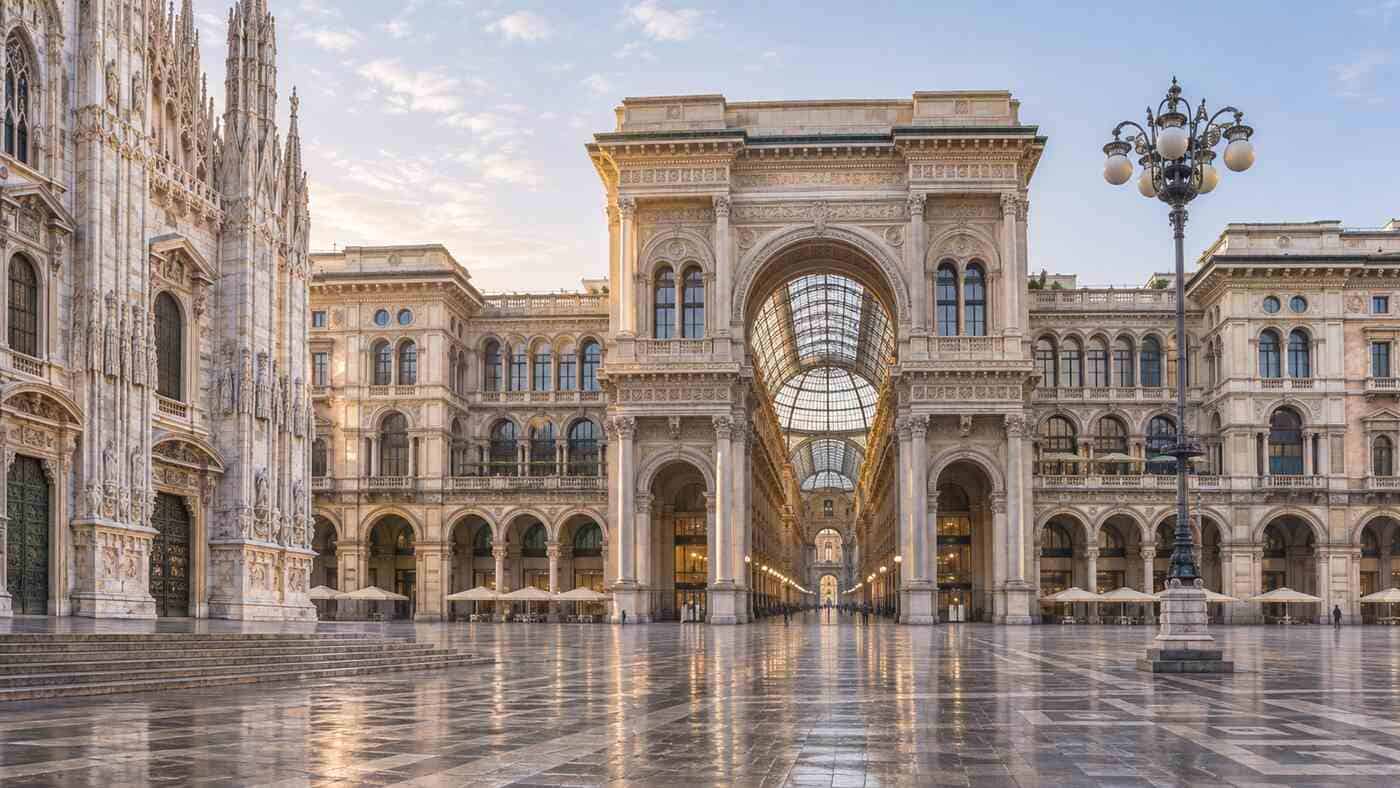
Milan held three design competitions between 1860 and 1863 for a new street linking the cathedral square with La Scala. Giuseppe Mengoni, an engineer from Fontanelice near Bologna, won the last one in 1863. King Victor Emmanuel II laid the first stone on 7 March 1865, according to Italian Wikipedia, and the king inaugurated the Galleria on 15 September 1867. The triumphal arch facing the cathedral took longer and was inaugurated on 24 February 1878.
Sources date the opening differently. English Wikipedia gives 1877 as the opening year and 1865 to 1877 as the construction period, counting the completion of the whole scheme; Italian Wikipedia separates the 1867 opening of the arcade from the 1878 opening of the arch. Both agree that Mengoni died in a fall from scaffolding in December 1877, days before the scheme was finished.
Construction was contracted to an English firm, the City of Milan Improvement Company. The firm failed in 1869 and the city took over the Galleria, paying 7.6 million lire of the time, according to Italian Wikipedia. The ironwork for the roof came from the Paris firm of Henry Joret, and English Wikipedia says the glass plates were made by Saint-Gobain.
The octagon, dome and glass roof
The plan is a cross. Italian Wikipedia gives the main arm as about 196 metres long and the cross arm about 105 metres, with each arm 14.5 metres wide. The vaults of the arms rise 29.2 metres and the lantern on top of the dome reaches 47 metres. The roof holds about 7,800 square metres of glass on 353 tonnes of steel.
The figures for the dome differ between the two Wikipedias. English Wikipedia gives an internal diameter of about 37.5 metres; Italian Wikipedia gives 39 metres for the diameter and 36 metres between opposite sides of the octagon. Either way, English Wikipedia notes that the vault spans were larger than those of earlier arcades such as the Galerie d’Orléans in Paris and the Galeries Royales Saint-Hubert in Brussels.
Look up from the octagon and you see four painted lunettes, each 15 metres wide at the base, representing Europe, Asia, Africa and America. Italian Wikipedia names the painters as Angelo Pietrasanta, Bartolomeo Giuliano, Eleuterio Pagliano and Raffaele Casnedi. Our article on the Galleria’s mosaics and decoration covers the lunettes, statues and floor in detail.
The bull mosaic and its tradition
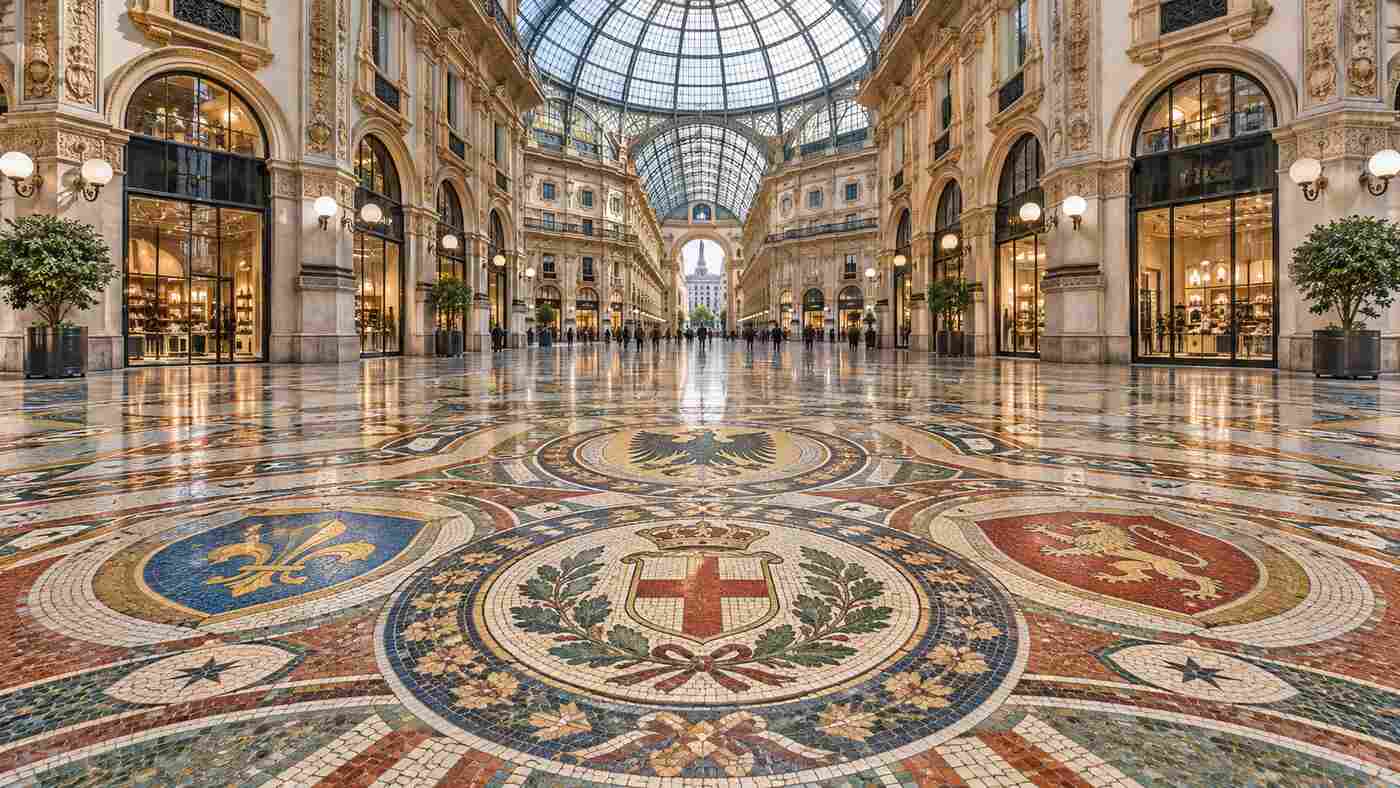
The floor of the octagon carries mosaics of the coats of arms of Milan and of the three capitals of the Kingdom of Italy: Turin, Florence and Rome. Turin’s arms show a rearing bull. A tradition says that spinning three times with a heel on the bull’s genitals brings good luck, and the BBC reported in November 2026 that the gesture is meant to guarantee a return to Milan.
The habit wears the mosaic away. English Wikipedia records restorations of the bull in 2017 and again in 2026. The BBC reported that in November 2026 the city set up a small work site around the mosaic, with an artisan cutting new stone pieces by hand, and quoted city councillors saying that thousands of people a day perform the spin. Sources disagree on the direction: the BBC describes visitors twirling clockwise, while Italian Wikipedia describes the right heel turning anticlockwise.
Shops, cafés and the hotel
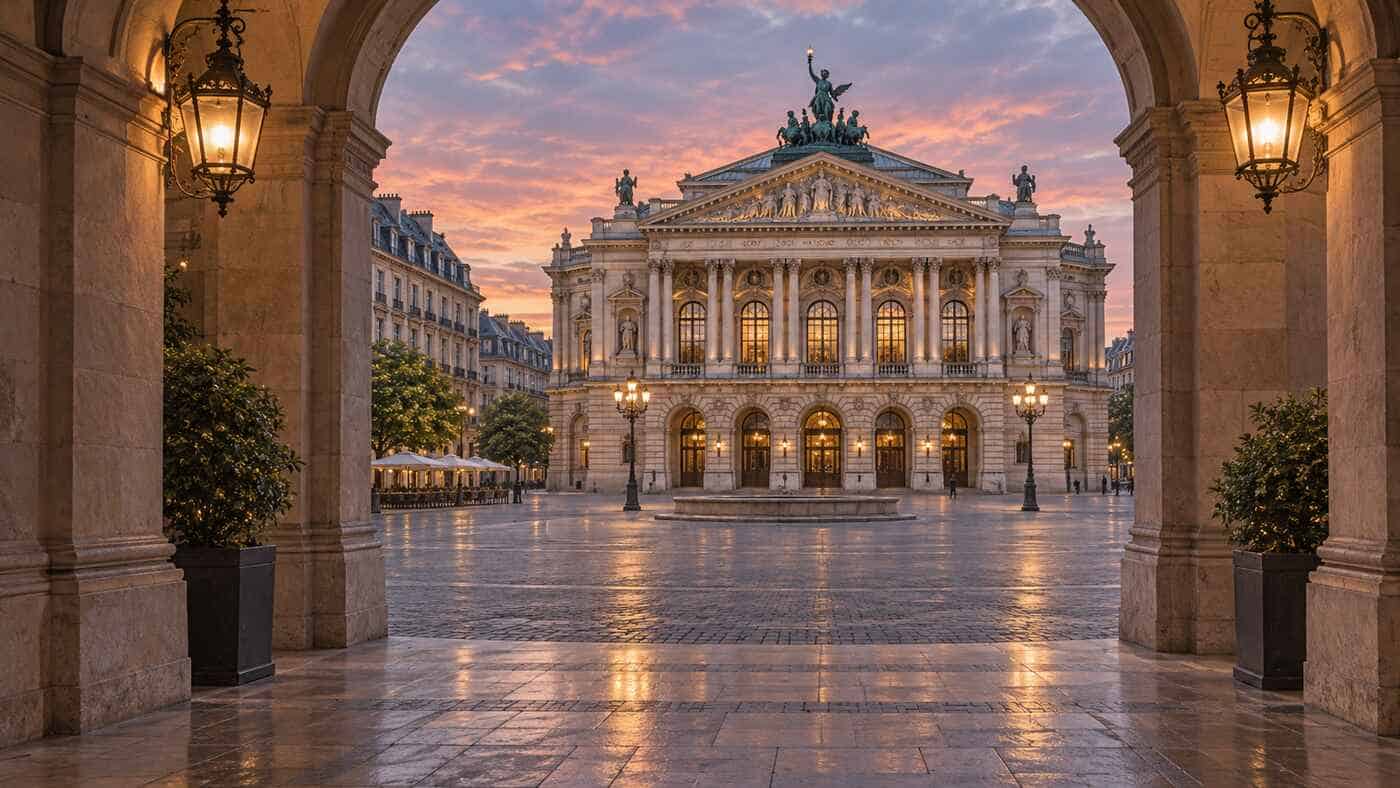
The Galleria holds some of Milan’s oldest businesses. Italian Wikipedia lists 12 shops recognised by the Lombardy Region as historic in 2015, including Caffè Biffi, Caffè Campari, Savini and the Libreria Bocca, as well as Fratelli Prada, which opened in 1913. City rules require gold lettering on a black background for shop signs, and Italian Wikipedia notes that even McDonald’s had to follow the rule when it traded there.
Spaces are let by public tender. The City of Milan reported in September 2021 that Gucci won a tender for the former Massimo Dutti space with an offer of 4.5 million euros a year, against a starting price of almost 3.1 million euros. There is also a hotel, Galleria Vik Milano, which describes itself as the Townhouse Galleria inside the monument. Our guide to shops and restaurants in the Galleria covers the historic names one by one.
Highline Galleria: the rooftop walk
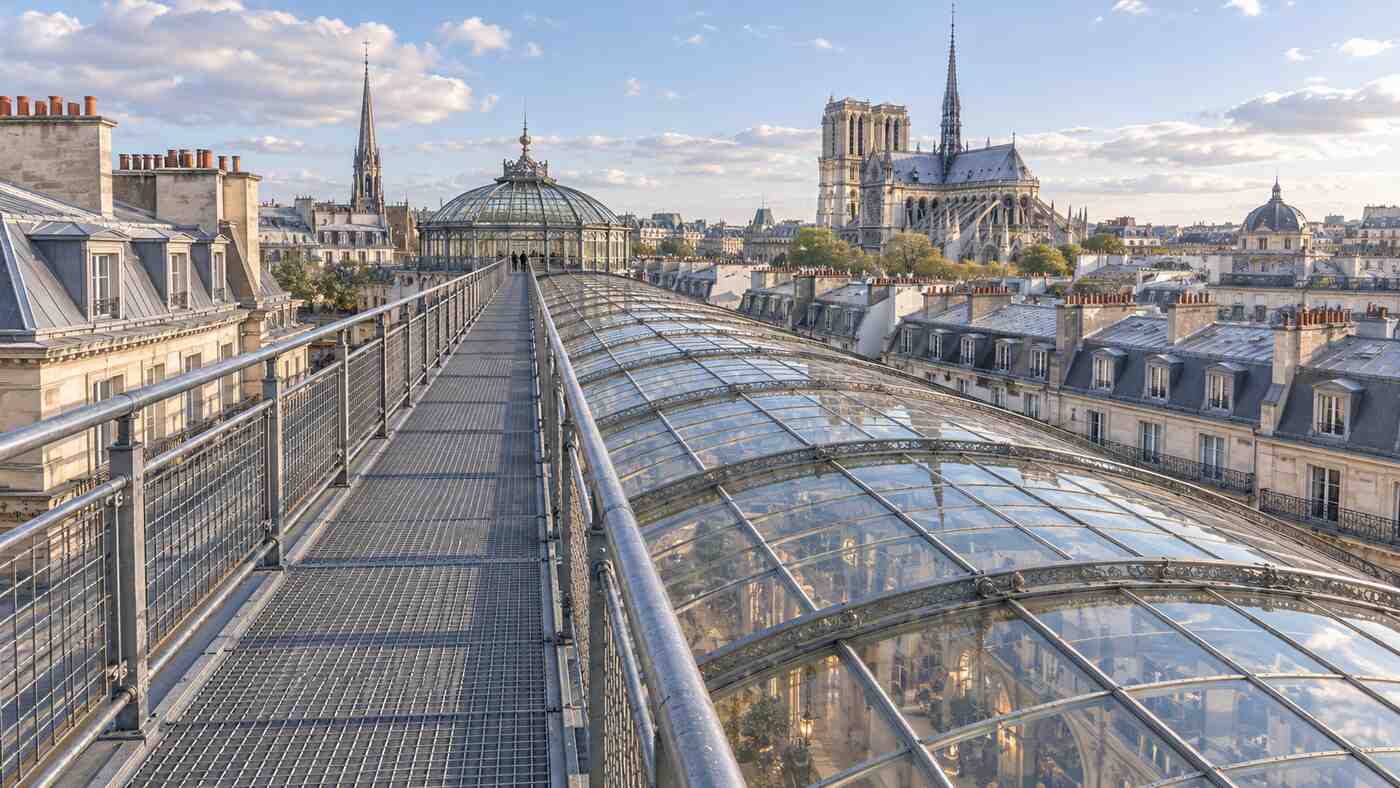
Since the 2010s visitors have been able to walk above the roof. Highline Galleria describes itself as a cultural hub and panoramic walkway suspended above the Galleria. Its official website lists opening hours of 10am to 6pm from Tuesday to Sunday, closed on Mondays, and says time slots have limited capacity and should be booked online. The entrance is at number 11/12, in the atrium on the Piazza della Scala side, and the route starts on the sixth floor.
A visit includes the walkway, a glass lift, an exhibition in the Sala degli Orologi and a terrace overlooking the Duomo, according to the operator. Prices change, so check the official site before you go.
How to visit the Galleria
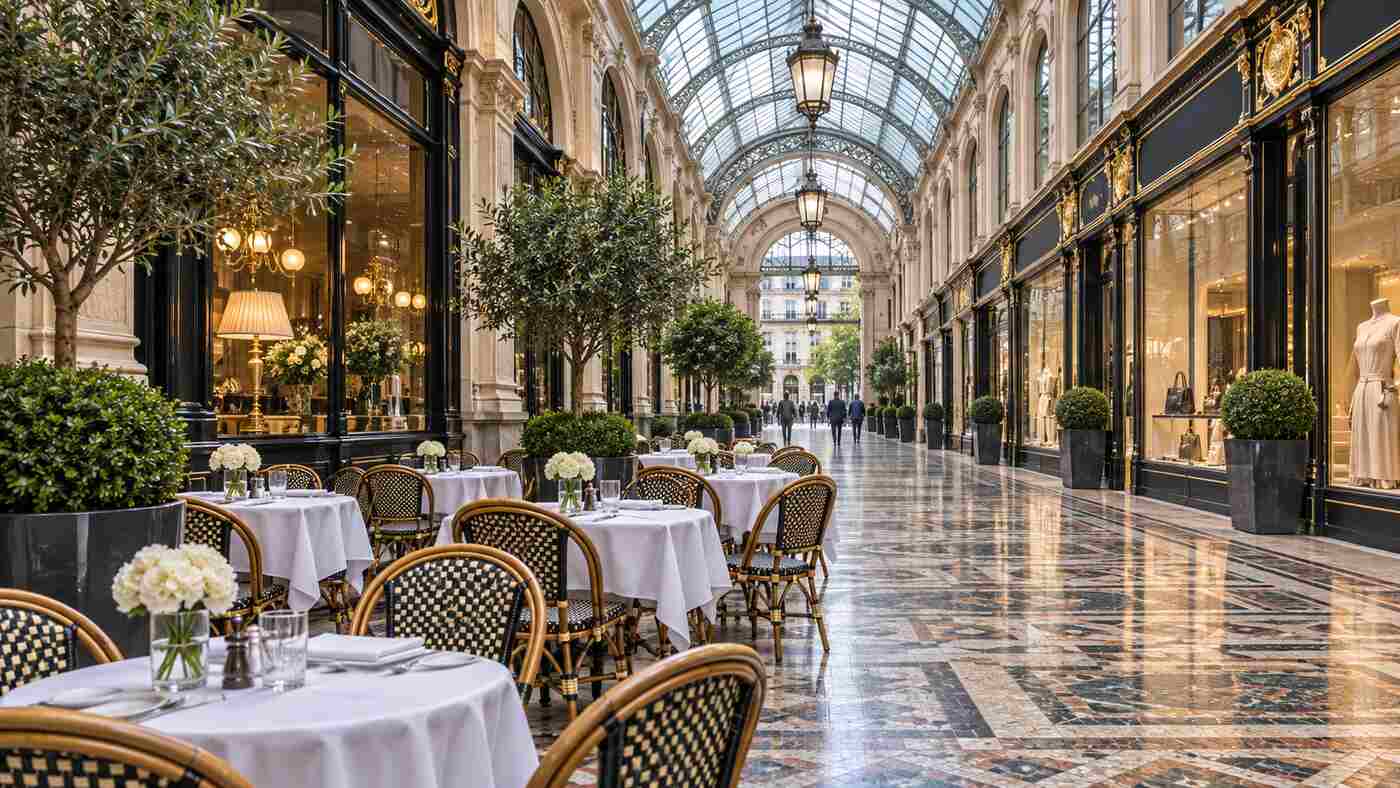
Because it is a city street, the Galleria has no ticket and no gate. Shops, cafés and restaurants keep their own hours. The two main entrances are the arch on Piazza del Duomo, next to the cathedral, and the exit on Piazza della Scala, opposite the opera house. The cross arm opens onto Via Silvio Pellico and Via Ugo Foscolo.
The building is still being looked after. The City of Milan announced in March 2024 two restoration projects worth about one million euros, on the façade in Via Marino and the roofs in Via Silvio Pellico, agreed with the heritage superintendency. Expect some work sites at any time. For the history of these campaigns read our article on restoring the Galleria.
What is near the Galleria?
The Galleria is the link between two of Milan’s best-known sights. At its north end, across Piazza della Scala, stands Teatro alla Scala, which opened in 1778; its museum is open every day and, when there is no rehearsal, lets visitors look into the auditorium. Our guide to Teatro alla Scala covers its history, tickets and the 7 December premiere.
At the south end the arch opens onto Piazza del Duomo and the cathedral, where you can climb 251 steps or take a lift to walk among the spires. See our guide to the Duomo rooftop terraces for official prices and hours. The Galleria’s idea of luxury shopping under one roof has also travelled far: our comparison with Bangkok’s luxury malls traces it to Asia.
Key takeaways
- The Galleria Vittorio Emanuele II is a public, glass-roofed street joining Piazza del Duomo and Piazza della Scala, owned by the City of Milan.
- Giuseppe Mengoni won the design competition in 1863; the arcade opened in 1867 and the entrance arch in 1878.
- The arms are 14.5 metres wide and the dome lantern rises 47 metres; sources give the dome diameter as 37.5 or 39 metres.
- The bull mosaic in the octagon is worn by a luck ritual and was restored again in 2026.
- Entry is free; the Highline rooftop walk is a separate, ticketed visit.
Common questions
Is the Galleria Vittorio Emanuele II free to enter?
Yes. It is a covered public street owned by the City of Milan, with no gates or tickets. You only pay for what you buy in the shops, cafés and restaurants, or for separate attractions such as the Highline rooftop walk, which has its own tickets and opening hours.
Why is it called Milan’s drawing room?
The nickname il salotto di Milano refers to its role as the city’s meeting place. English Wikipedia links the name to its shops and its importance for meeting and dining. It lies on the direct route between the cathedral and La Scala, so many Milanese pass through it every day.
How old is the Galleria?
The first stone was laid on 7 March 1865 and the king inaugurated the arcade on 15 September 1867. The entrance arch on Piazza del Duomo followed on 24 February 1878. Some sources use 1877, the year the whole scheme was completed, as the opening date.
Where is the bull mosaic?
It is in the floor of the octagon, the central space under the dome, among the mosaics of the coats of arms of Milan, Turin, Florence and Rome. The bull belongs to Turin’s arms. It is easy to find, because there is usually a small queue of people waiting to spin on it.
Who owns the shops in the Galleria?
The City of Milan owns the building and lets the spaces to tenants, often by public tender. In 2021 the city reported a tender for one space that ended with an annual rent offer of 4.5 million euros. Signs must use gold letters on a black background.
How we put this together: this guide draws on English and Italian Wikipedia, two City of Milan announcements from 2021 and 2024, the Highline Galleria website, the BBC’s November 2026 report on the bull mosaic and the Galleria Vik Milano website. Where these sources give different dates or measurements, we show both. We have not added anything from personal visits.
What is there to see near the Galleria?
Teatro alla Scala is at the north end, across Piazza della Scala, and the Duomo is at the south end. Both can be visited in a morning; see our guides to La Scala and the Duomo rooftop.
Sources
- Wikipedia, Galleria Vittorio Emanuele II
- Wikipedia (Italian), Galleria Vittorio Emanuele II
- City of Milan, two restoration projects worth one million euros (2024)
- City of Milan, new assignments for spaces in the Galleria (2021)
- Highline Galleria, official website
- BBC News, Milan restores bull mosaic worn down by tourists (2026)
- Galleria Vik Milano, official website